Radiesse vs. Sculptra: Two Roads to Collagen, One A Much Smoother Ride
Jan 7, 2025
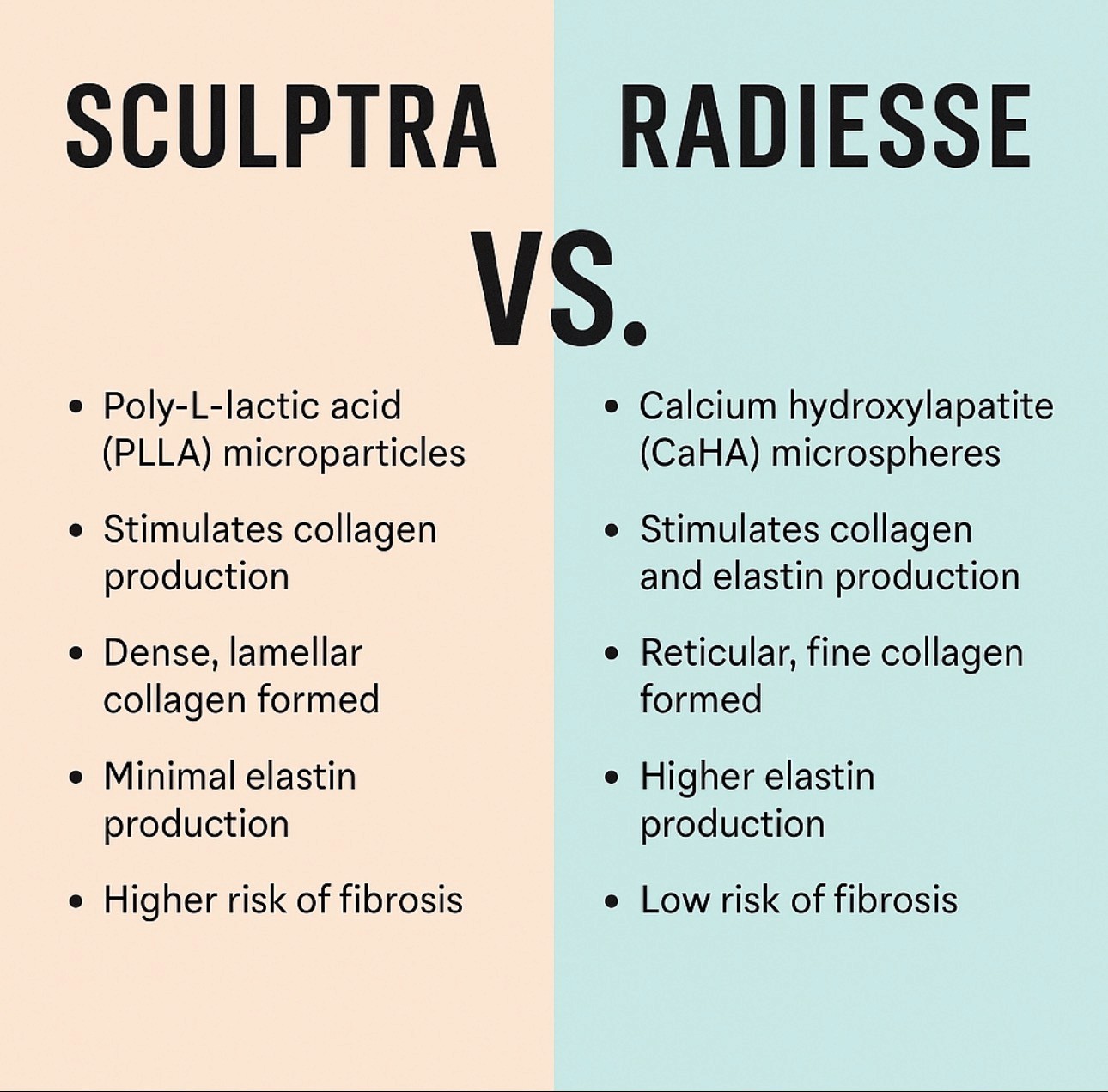
The Age-Old Problem: The Scaffold Collapses First
The visible signs of aging aren’t about surface lines—they’re about the deeper infrastructure failing. The skin’s reticular dermis and retinaculum cutis (the fibrous ligaments tethering skin to fascia) loosen, collagen thins, elastin frays, and the whole suspension system sags.
That’s where biostimulatory fillers—not traditional hyaluronic acids—come in. Unlike instant-fill gels, these products work by triggering your own fibroblasts to rebuild collagen, and in some cases, elastin. Two of the most widely used are Radiesse and Sculptra. Both aim to rejuvenate the dermal framework from within, but their mechanisms, inflammation levels, and outcomes couldn’t be more different.
The Basic Chemistry
Feature Radiesse Sculptra
Active Ingredient: Calcium Hydroxylapatite Poly-L-Lactic Acid (PLLA)
Particle Type: Mineral-based/smooth/inert Synthetic polymer/biodegradable
Carrier: Carboxymethylcellulose gel. Sterile water + mannitol + CMC
Injection Plane: Deep dermis or subdermal Deep dermis or subnormal
Effect Timeline: Immediate + progressive. Delayed (builds over months)
How Each Works at the Cellular Level
Radiesse: The Silent Architect
Think of Radiesse as scaffolding that wakes up lazy fibroblasts without starting a fire. The CaHA microspheres provide immediate volume and act as a matrix for tissue regeneration.
Once in place, fibroblasts migrate along the spheres, laying down new Type I and III collagen, elastin fibers, and proteoglycans. Proteoglycans are one of the unsung heroes of the extracellular matrix—the molecular glue that holds your skin (and basically everything else) together.
They’re large, complex molecules made of a core protein with long chains of glycosaminoglycans (GAGs) attached. Those GAGs are sugar-based chains—like hyaluronic acid, chondroitin sulfate, and dermatan sulfate—that attract and hold massive amounts of water.
Think of proteoglycans as hydrated shock absorbers embedded within the collagen–elastin scaffold. They keep the matrix bouncy, hydrated, and nutrient-permeable—vital for fibroblast function and for cushioning between collagen fibers.
This process is guided, low-grade, and organized. Over months, the gel carrier resorbs, leaving behind a newly woven extracellular matrix that reinforces the dermal reticulum and retinacular ligaments—the skin’s internal suspension system.
Histologic studies show fine, reticular collagen and renewed elastic fibers, not fibrosis. (Yutskovskaya et al., J Drugs Dermatol, 2017; Berlin et al., Dermatol Surg, 2008.)
The end result is not just smoother skin, but firmer, more resilient skin—the kind that “snaps back” instead of folding.
Sculptra: The Provocateur
Sculptra takes the opposite approach: it deliberately provokes a controlled inflammatory reaction. The PLLA microparticles are recognized as foreign, triggering macrophages and giant cells to release cytokines—IL-1β, IL-6, TNF-α, and TGF-β1.
That cytokine surge calls in fibroblasts, which deposit Type I collagen around each PLLA crystal in concentric rings. The process unfolds slowly over months as the particles degrade into lactic acid.
It’s biologic remodeling through controlled irritation—a bit like setting off a fire alarm to remind the building to fix itself.
The collagen formed is dense and lamellar, not elastic. Histology shows fibroplasia with multinucleated giant cells, confirming that the process is more inflammatory than regenerative. (Vleggaar, Dermatol Surg, 2004; Valantin et al., HIV Med, 2005.)
Elastin: The Forgotten Protein
Collagen gives skin strength, but elastin gives it bounce—and that’s where the two fillers diverge sharply.
Radiesse has been shown in biopsy studies to increase elastin production along with collagen (Yutskovskaya 2017; Gotkin 2018). This dual stimulation improves elasticity and recoil.
Sculptra, despite its volumizing power, does not significantly stimulate elastin. The fibroblast activity it triggers is geared toward structural repair, not elasticity.
In short: Radiesse builds structure and spring; Sculptra builds structure only.
Fibrosis and Safety
Because Sculptra works through a sustained inflammatory response, it carries a higher risk of fibrosis and granuloma formation—especially if over-concentrated or injected too superficially.
Histologic evidence shows dense fibrotic collagen sheaths around residual PLLA fragments.
Clinically, this can manifest as palpable nodules or firmness months later.
Radiesse, conversely, induces low-grade fibroplasia without fibrosis.
The microspheres are biocompatible and smooth, leading to organized collagen deposition rather than scarring.
True granulomas are exceedingly rare.
Translation: Sculptra’s inflammation builds, but can overshoot. Radiesse’s scaffold builds, then fades quietly.
Trait Radiesse Sculptra
Inflammation level Low Moderate
Collagen Type I & III Mostly I
Elastin Stimulation Yes Minimal
Fibrosis Risk Low Higher
Onset Immediate, builds over 6–12 weeks Delayed (2–4 months)
Duration 12–18 months 24+ months (with series)
Ideal Use Tightening, texture, elasticity Skin thickening/fullness
Texture Outcome Firm, springy, “youthful” Thick, structural
The Verdict: Both Builders, Different Blueprints
Both Radiesse and Sculptra rebuild the dermal framework—but their philosophies differ.
Radiesse behaves like an engineer: lays a scaffold, directs fibroblasts, and leaves behind ordered collagen and elastin. Repaira and restore functional tissue. Regenerative,
Sculptra behaves like an agitator: ignites a biologic cascade, which—if balanced—produces robust collagen, but at the cost of greater inflammation.
Neither is “better” in all cases; they simply serve different purposes.
Use Radiesse where you want lift, tightening, and elasticity—jawline, neck, arms, lower face.
Use Sculptra where you need structural volume—cheeks, temples, or global facial restoration.
Bottom line:
Both products tell your fibroblasts to rebuild—but Radiesse whispers directions, while Sculptra shouts orders. The result?
Radiesse gives you snap-back skin; Sculptra gives you slow, sculpted structure.
Both have their place—but understanding their biology is how we turn filler injection into true regenerative medicine.
References (PubMed)
Berlin AL et al. Dermatol Surg. 2008;34(Suppl 1):S64–S67. PMID: 18318889
Lemperle G et al. Plast Reconstr Surg. 2010;126(6):2232–2240. PMID: 21042191
Yutskovskaya Y et al. J Drugs Dermatol. 2017;16(6):605–610. PMID: 28582522
Gotkin RH et al. Dermatol Surg. 2018;44(Suppl 1):S5–S14. PMID: 29688910
Vleggaar D. Dermatol Surg. 2004;30(7):767–775. PMID: 15274698
Valantin MA et al. HIV Med. 2005;6(1):41–45. PMID: 15663714
Fitzgerald R et al. Aesthet Surg J. 2018;38(Suppl 1):S33–S40. PMID: 29897549
This Substack is reader-supported. To receive new posts and support my work, consider becoming a free or paid subscriber. FACTS NOT HACKS